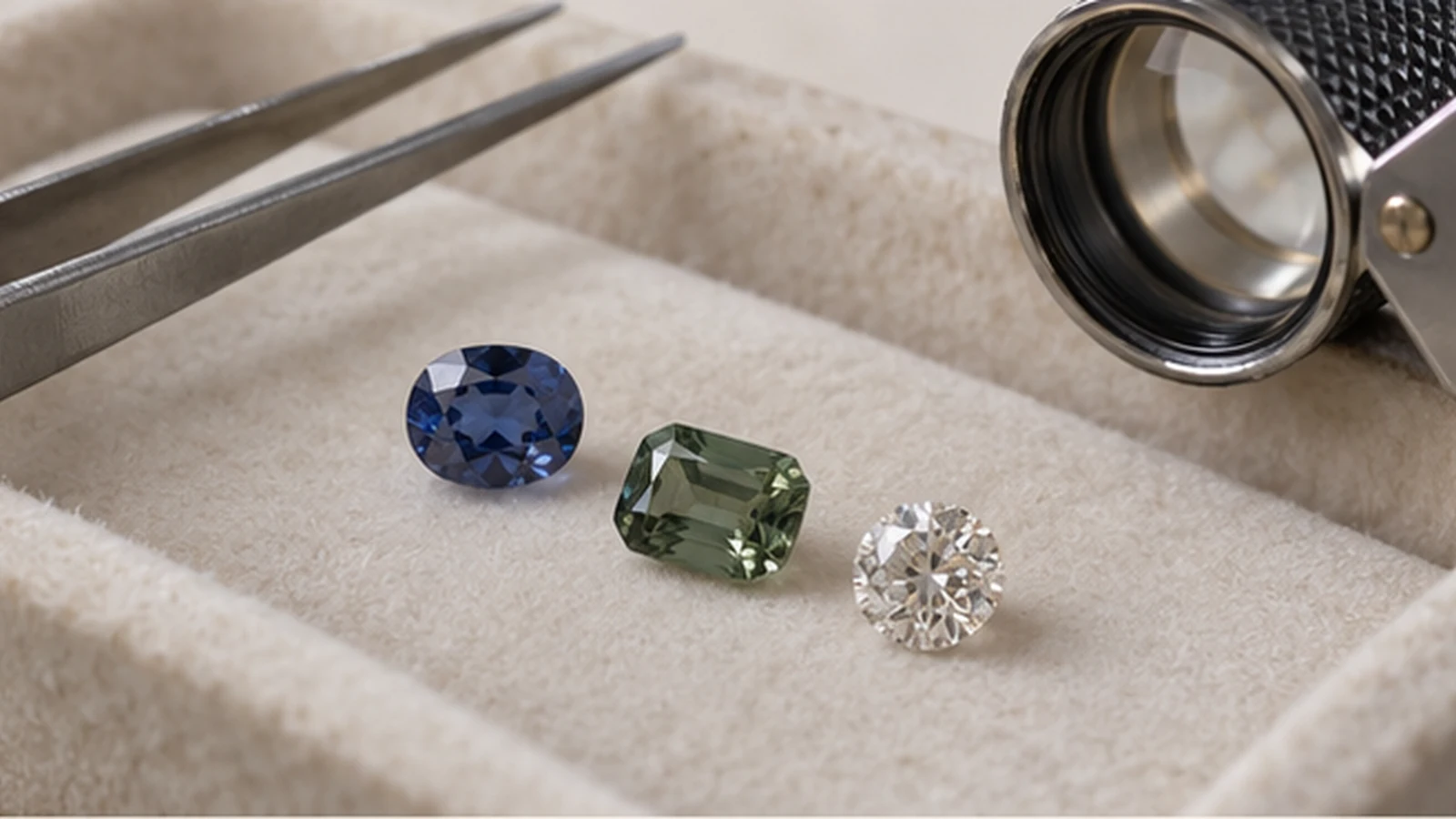
A gemstone is more than its colour, cut or carat weight. Every stone has travelled through a chain of people and places before reaching the jeweller’s bench. It may have been mined in one country, cut in another and passed through several hands before finding its way into a finished piece.
For me, understanding something about that journey is an important part of choosing a gemstone.
But words such as traceable, responsibly sourced and ethical are often used rather loosely. They are related, but they do not necessarily mean the same thing.
So what does gemstone traceability actually tell us – and what can it not tell us?
What is a traceable gemstone?
In its clearest form, traceability means being able to follow a gemstone through its supply chain.
That might include information about:
- The country or region where it was mined
- The mine or mining community
- Who purchased or exported the rough material
- Where the gemstone was cut
- The suppliers who handled it
- Any treatments applied to the stone
The amount of information available varies considerably. One gemstone may have a documented journey from a particular mine to the finished piece, while another may only be traceable to a country, region or trusted supplier.
I do not believe those differences should be hidden behind a single reassuring label. Good practice begins with being clear about what is genuinely known.
Why can coloured gemstones be difficult to trace?
Coloured-gemstone supply chains are often complex.
Many gemstones are produced through artisanal or small-scale mining and may pass through local traders, exporters, cutters and international dealers. Cutting may take place thousands of miles from the original source, and older stones may have entered the jewellery trade before detailed record-keeping became common.
This does not automatically mean that a gemstone has been irresponsibly sourced. It means that complete mine-to-market documentation is not always available.
The important question is therefore not simply, “Is this gemstone traceable?” It is also, “How far can it be traced, and what evidence supports that information?”
What can a gemmological report tell you?
An independent gemmological report can provide valuable information about a gemstone. Depending on the report and the type of stone, it may identify:
- Whether the gemstone is natural or laboratory-grown
- Its gemstone species and variety
- Detectable treatments
- Its weight, measurements and physical characteristics
- An opinion about its geographical origin, where this can be determined
However, a laboratory report is not automatically a record of the gemstone’s complete supply chain.
The Gemological Institute of America explains that geographical-origin conclusions are based on gemmological characteristics, inclusions and scientific analysis. Even then, an origin may sometimes be inconclusive. Reports offering an origin opinion are also only available for particular gemstone types. GIA’s coloured-stone reports therefore provide one form of evidence, rather than a complete ethical history.
Does traceable automatically mean ethical?
Not necessarily.
Traceability provides visibility. Responsible sourcing involves using that information to consider matters such as working conditions, environmental practices, human rights and the way value is distributed through the supply chain.
A gemstone could theoretically have a well-documented journey without every stage meeting the standards we might hope for. Equally, a stone may have been sourced through a responsible and trusted relationship without having perfect documentation at every step.
This is why I prefer careful questions to absolute claims.
The World Jewellery Confederation’s responsible-sourcing guidance treats this as a process of due diligence: gathering information, assessing potential risks and responding appropriately rather than relying on a single label or certificate. CIBJO’s Responsible Sourcing Toolkit provides guidance for businesses throughout the gemstone and jewellery supply chain.
What do I look for when choosing gemstones?
I work with specialist suppliers who are willing to discuss where their gemstones come from and how they have travelled through the supply chain.
Depending on the stone, I may ask:
- What is known about its country, region or mine of origin?
- Who supplied and cut the gemstone?
- Is supporting documentation available?
- Has the stone received any treatment?
- How confident is the supplier in the information provided?
- Are there any gaps or uncertainties that should be explained?
I also consider the gemstone itself: its condition, durability, treatments and suitability for the proposed design. A beautiful stone must work practically as well as emotionally, particularly if it will be worn every day in an engagement ring.
Most importantly, I aim to share what is known honestly. If some part of a gemstone’s history cannot be verified, I would rather explain that limitation than create a certainty that does not exist.
Choosing a gemstone with confidence
Traceability is not about finding a perfectly documented gemstone in every situation.
It is about asking better questions, valuing greater transparency and making an informed decision with the information available.
A gemstone may capture your attention because of its extraordinary colour, an unusual inclusion or the landscape suggested by its internal markings. Learning more about its journey does not diminish that sense of wonder. For me, it adds another layer to the story.
When you choose a gemstone for a bespoke ring or future heirloom, you are not simply choosing something beautiful.
You are choosing which materials, relationships and stories will become part of your own piece – and which values you would like it to carry forward.