
Choosing a wedding ring is not always as simple as finding a band you love.
If it will be worn alongside an engagement ring, the two pieces need to work together visually and practically. Their shapes, settings, widths and proportions all affect how comfortably they sit as a pair.
Some engagement rings will accommodate a straight wedding band beautifully. Others need a curved, shaped or completely bespoke ring to follow the outline of the setting.
There is no single right answer. The aim is to create a pairing that feels balanced, comfortable and right for you.
Begin with the engagement ring
The engagement ring should always be the starting point.
Its profile, setting height and gemstone arrangement will determine how closely another ring can sit beside it. A high-set solitaire may leave enough space underneath the setting for a straight band, while a low-set gemstone, cluster or asymmetric design may interrupt the line of the wedding ring.
Even small details can make a difference. Claws, side stones and the width of the engagement-ring band can all influence the shape and proportions required.
This is why I prefer to assess the actual engagement ring before finalising a fitted wedding-ring design. Designing from photographs or approximate measurements can only reveal so much.
Does a wedding ring have to sit flush?
No. Some people love the appearance of two rings sitting closely together with almost no visible space between them. Others prefer a small gap because it allows each ring to retain its individual outline.
A gap can look completely intentional, particularly when the rings have contrasting profiles, textures or widths. There is no rule stating that an engagement ring and wedding ring must appear to form one continuous design.
What matters is that the space feels considered and the rings sit comfortably without pressing awkwardly against one another.
When will a straight wedding ring work?
A straight wedding band may work when the engagement-ring setting is raised sufficiently above the finger or when the widest part of the setting does not extend beyond its band.
This can be an elegant option for somebody who wants a classic wedding ring that can also be worn independently. Court, D-shaped, flat and flat-court profiles can all create different relationships with the engagement ring while retaining a timeless form.
The width matters too. A slim band may sit unobtrusively beside an elaborate engagement ring, while a wider band will create a stronger visual presence.
The best way to judge this is to try different proportions alongside the engagement ring rather than viewing the wedding ring in isolation.
When might you need a shaped wedding ring?
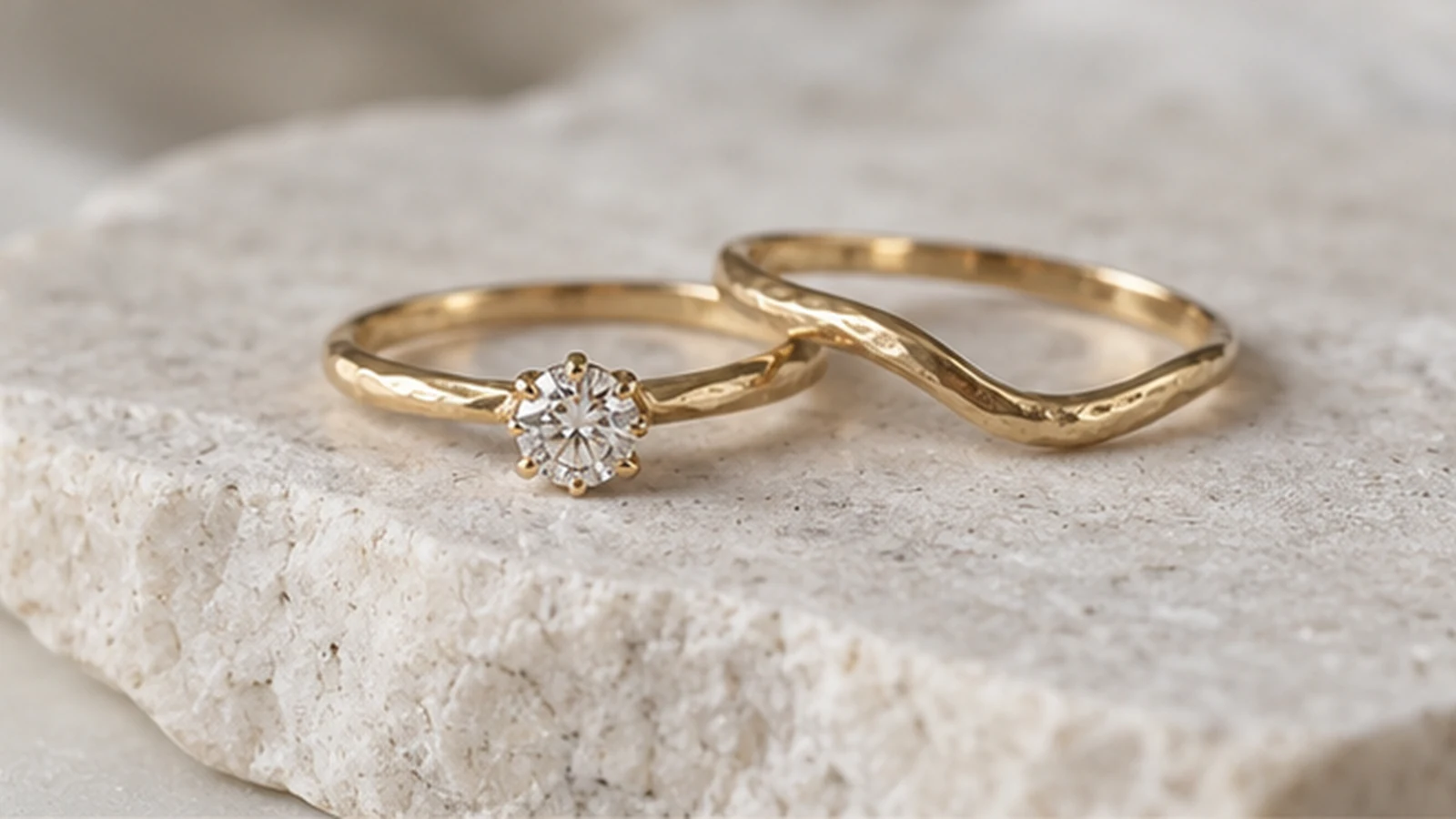
A shaped or contoured wedding ring follows some part of the engagement ring’s outline.
It may incorporate a gentle curve around a central setting, a more angular V or chevron, or an asymmetric form designed around an unusual gemstone arrangement. The shape can be extremely subtle or become an expressive design feature in its own right.
A shaped wedding band is particularly useful when a straight ring would leave an awkward gap or push against the engagement-ring setting.
For me, the most successful shaped rings do not feel like an afterthought. They have their own rhythm and character while creating a clear relationship with the engagement ring.
They can also be designed to look beautiful when worn separately, although this needs to be considered from the beginning if independent wear is important to you.
Consider how the rings touch
The point where two rings meet deserves careful attention.
If a wedding band repeatedly rubs against a gemstone setting, claws or delicate decorative detail, this may contribute to wear over time. Different profiles and surface details can also affect how the rings move against one another.
A little movement between rings is normal, but the pairing should not feel as though one piece is forcing the other out of position.
Looking at the rings from above and from the side helps reveal where contact occurs and whether the proposed shape provides enough space around the setting.
Should the rings match?
Your wedding ring can echo the engagement ring without copying it exactly.
You might repeat the same precious metal, surface finish or gemstone detail. Alternatively, you could introduce a contrasting texture, a different width or a complementary profile.
Matching the metal can create a harmonious appearance, but it is not the only option. If you are considering combining different precious metals, it is worth discussing their practical qualities as well as their colours.
The most important thing is that the relationship feels deliberate. Two rings can be connected through a single subtle detail while retaining very different personalities.
When is a bespoke wedding ring the best choice?
A bespoke wedding ring is often the most appropriate solution when the engagement ring has an unusual outline, low setting, asymmetric design or complex arrangement of gemstones.
The ring can be designed around the engagement piece itself, with its curve and proportions developed to create a considered fit. There may also be opportunities to incorporate gemstones, engraving, texture or personal symbolism into the design.
You do not need to arrive with a finished idea. Bringing the engagement ring to a consultation allows us to explore straight and shaped options, compare widths and profiles, and work out what feels most natural on your hand.
It is best to begin this conversation well before the wedding, particularly if the design will be bespoke or technically complex.
Creating a pairing that belongs together
An engagement ring and wedding ring do not need to be identical, perfectly symmetrical or completely flush to feel as though they belong together.
They simply need to have a thoughtful relationship.
That might come from a shared curve, a repeated texture, the space deliberately left between them or the contrast between two distinct designs.
The right wedding ring should complement the engagement ring without losing its own identity – creating a pairing that feels comfortable, personal and made to accompany you through everyday life.