
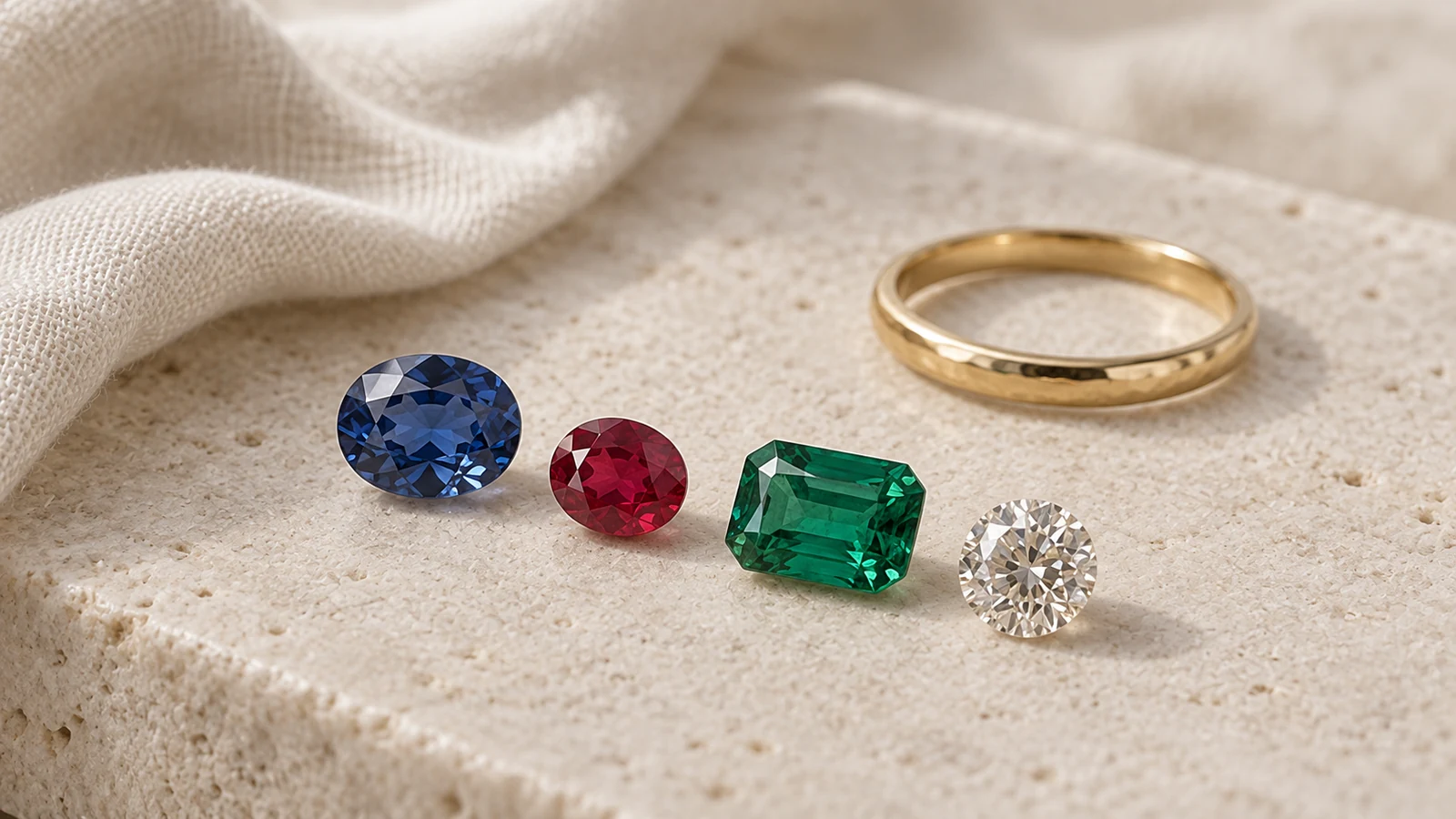
Sometimes it is a colour that draws you to a gemstone. A particular green, a deep blue or a warm pink may feel immediately right. Sometimes the connection is more personal: a birthstone, a family memory or simply a stone you have always loved.
An engagement ring can hold any of those meanings. But because it is often worn every day, choosing its gemstone also involves a few practical considerations. For me, the starting point is finding a stone you love, then understanding how it will fit into your life. Beauty, suitability and thoughtful design all belong in that conversation.
What makes a gemstone suitable for everyday wear?
You may have come across the Mohs scale, which describes how resistant a gemstone is to scratching. It is useful, but it does not tell us everything. Toughness matters too: how well a stone resists chipping or breaking. We also need to consider its response to heat, chemicals and changes in temperature. GIA’s explanation of gemstone durability describes these as three separate qualities.
A hard gemstone is not necessarily an unbreakable one. Its condition, any treatments and the way it is set all influence how comfortably it can be worn.
It helps to think honestly about your everyday habits. Someone who works with their hands may need a different design from someone who is happy to remove their ring regularly.
Sapphire and ruby: strong options for an engagement ring
Sapphire and ruby are both varieties of corundum. They combine excellent scratch resistance with good resistance to knocks, making them strong choices for rings intended for frequent wear. GIA’s care guidance explains why this combination matters.
Sapphire also offers far more choice than its familiar blue. Pink, yellow, green and other shades can bring a very different character to a ring. Ruby offers its own rich range of reds. Their colour can be expressive without requiring an elaborate setting. A carefully chosen stone in a simple design may be all that is needed.
Even with these durable gemstones, the individual stone and any treatments should be considered before the design is finalised.
Does an engagement ring have to contain a diamond?
Not at all. Diamond is a familiar choice, and its exceptional resistance to scratching makes it practical for everyday wear. But it can still chip, particularly if an exposed edge receives a sharp impact.
Choosing a diamond should come from your own connection with the stone rather than a feeling that an engagement ring must look a certain way.
If you are drawn to diamonds, my guide to understanding diamonds introduces the qualities that help shape their appearance and character.
Can an emerald be used in an engagement ring?
Yes, but it deserves a more careful conversation. Emerald’s green can be wonderfully compelling. However, it generally requires more care than sapphire or ruby. Fractures within a stone, and the oils or resins sometimes used to improve its appearance, can affect how it should be worn and cleaned. GIA’s emerald guidance explains these considerations.
That does not mean ruling emerald out. It means assessing the particular stone, choosing an appropriate setting and being comfortable with the care it will need.
If you love green but would prefer a different balance of durability and care, other gemstones may be worth exploring.
What about less familiar gemstones?
Spinel is worth considering. It offers a beautiful range of colours and combines good toughness with a hardness of eight on the Mohs scale. GIA’s spinel guide provides more detail about its durability and care.
Other gemstones require greater caution. Opal, for example, is more vulnerable to scratches and damage, while tanzanite is generally better suited to occasional wear than the demands of an everyday engagement ring.
There is room for personal choice, but it should be an informed one. A stone you adore may suit another piece of jewellery better, allowing you to enjoy it without worrying about every knock.
The setting is part of the decision
A gemstone should never be considered separately from its setting. A setting that surrounds vulnerable edges with metal can offer useful protection. The height of the stone, the security of its claws and any exposed corners also deserve attention.
Protection does not make a delicate gemstone indestructible, but thoughtful design can help a ring feel more practical and comfortable to wear.
It is also worth considering the wedding ring at this stage. My guide to choosing a wedding ring to fit around your engagement ring explores how the two pieces can work together.
Choosing with provenance in mind
Suitability is only one part of choosing a gemstone. Its origin, treatment history and journey through the supply chain may matter to you too.
I believe those questions deserve clear answers, including an honest explanation of any information that is unavailable. My guide to traceable gemstones looks more closely at what we can learn about that journey.
Finding the stone that feels right
There is no single gemstone that is right for everyone.
The most useful choice brings together the colour and character you love, the care you are comfortable with and a design that suits the way you live.
If you have a particular gemstone in mind, or would like help exploring the possibilities, you are welcome to get in touch. A conversation can help turn an initial attraction into a ring that feels personal, thoughtfully made and ready to become part of your story.